

The red earth of Western Australia’s Pilbara holds the world’s largest deposits of iron ore. This harsh and remote region is now home to a network of technologically-advanced mines extracting millions of tonnes of iron ore to meet global demand for steel. It is possible to visit one of the oldest operating mines in the region, near the town of Tom Price.
Whilst flying through the Pilbara in 1952, farmer Lang Hancock was forced by bad weather to fly through rather than over the Hamersley Ranges. Following the Turner River, Hancock noticed distinctive rust-coloured rocks, which he correctly assumed revealed the presence of vast quantities of iron ore. By 1966 Australia had relaxed a ban on the export of iron ore, and with growing Japanese and US demand, Hammersley Iron opened their first mine in the Pilbara.
Over the following decades more mines were opened, and a network of railways were created to bring the ore to ports on the North coast of Western Australia. A new town was created to house miners and their families, and was named after Thomas Price, a Vice-President of the American Kaiser Steel company and a support of mining in the Pilbara.
Several mergers later, 17 mines in the Pilbara are now owned by Rio Tinto, are connected by 2,000 km of rail to four ports, and produce 324 million tonnes of iron ore annually. The operation is increasingly advanced with automated hauling trucks and water carts in use in the mines, and driverless, 2.4km-long trains taking the iron ore 800 km north to the coast.
How to visit
Tours of the nearby Mt Tom Price mine depart from the Tom Price Visitor Centre in the town itself. Tours last 1.5 hours and currently cost A$44 per person and A$19 for children under 14. They are irregular and do require advance booking. There’s an online booking option, but at this is only showing limited availability from May 2024 onwards, we’d recommend contacting the Tom Price Visitor Centre at [email protected] to see when the tours are offered.
The nearest airport is Paraburdoo, with regular flights shuttling mine workers up from Perth. You’ll need a car when you’re in the region unless you’re exclusively taking tours. We came to the Pilbara from Exmouth where we had been visiting the Ningaloo Reef. It’s a long way – 570 km, taking about 7 hours. The Nanutarra roadhouse is roughly equidistant between Exmouth and Tom Price and is a helpful stop for fuel and food.
Given visitors are largely on a coach there aren’t particular safety or mobility concerns. You are required to wear closed shoes – no thongs, mate – and are issued with safety equipment.
Our experience
Visitors are kitted out with a hardhat and safety glasses at the Visitor Centre, and then board a mercifully air-conditioned coach for the short drive out to the mine. The coach driver doubles up as the tour guide and narrates a brief history of the mine and the region.
The tour takes visitors through various areas of the mine. We drove past the repair bay, where the huge hauling trucks and other vehicles are maintained, and then on to the pit lookout, where we were allowed out of the coach. The parking lot has a now disused hauling truck, several metres high, which provides a helpful sense of scale as you look down on the same trucks appearing toy-sized in the pit itself.
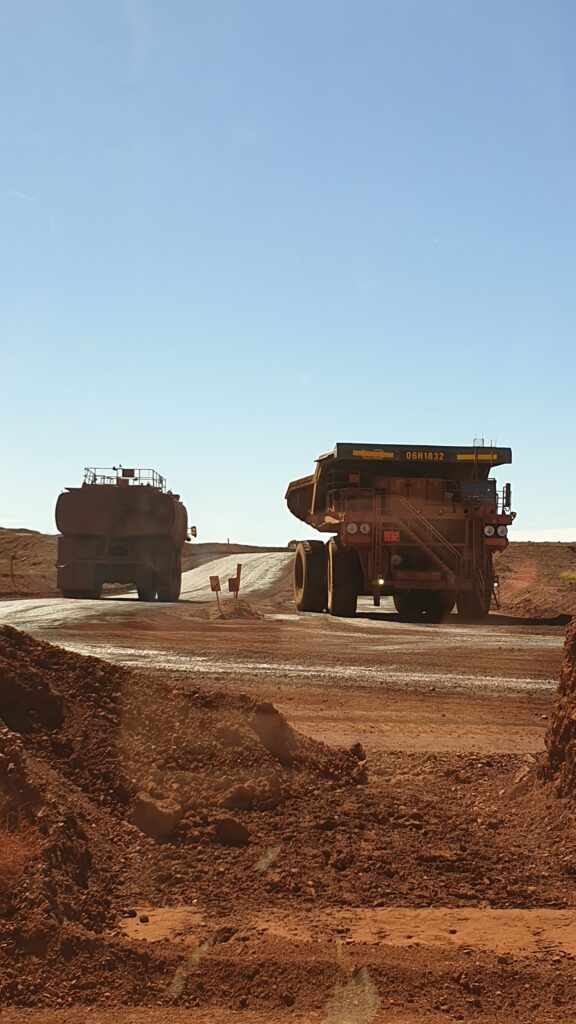
We then got back on the coach for a further drive around the mine. We paused a one point to allow one of the hauling trucks to pass, followed by a cart spraying water to keep the dust down (and then adding to the Australian-ness of it all, a dingo ran across behind the water cart). We followed the hauling trucks to the processing plant where the iron ore is crushed and graded, and then on to where the ore is loaded aboard the trains that will take it to port.
The sheer scale of the operation is undoubtedly impressive, and there’s something almost unnerving about it – this tearing out of ever bigger chunks of the land, to feed a seemingly insatiable appetite for iron ore. That said, the tour lacked a little of the intimacy and depth we’ve experienced in other places. There were around 30 of us when we went and, other than the pit lookout, you’re on the coach the whole time which has the practical limitation of requiring you to take photos through dusty windows. It doesn’t justify a special visit to the region given its remoteness, but if you’re heading to the spectacular Karijini National Park nearby, it’s well worth a look.