

The Kelham Island Museum houses exhibits related to the industrial history of Sheffield. It’s an appropriate location. Kelham Island sits on the River Don, just north of the city centre, and has been home to grinding workshops and later an iron foundry. The museum buildings were originally erected in the 1890’s to house an electricity generating station for the city’s tram system, which operated until the 1930’s.
The museum tells the story of how Sheffield’s came be known as the Steel City. By the 14th century Sheffield was already famed throughout England as a manufacturer of knives and other cutlery, with 25% of the city’s population employed in metalworking in 1379. This came about through a combination of geographical factors – particularly the profusion of rivers that could be harnessed to power grindstones, and Sheffield’s distance from major waterways and the sea making it harder to ship larger goods – and happenstance.
This experience, and the proximity of the South Yorkshire coalfields, meant that Sheffield was well placed to benefit when coke replaced charcoal in blast furnaces. Sheffield steel makers began producing blister steel using cementation furnaces from 1709 onwards, using iron often imported from Sweden.
Frustrated by the limited suitability of the blister steel for precision components, Sheffield-based watchmaker Benjamin Huntsman invented the crucible steel process in 1742. By melting blister steel in clay melting pots, called crucibles, higher quality steel could be produced.
Sheffield was also to benefit from the next major breakthrough in steel production. In 1856 Henry Bessemer announced a new process to make steel, using egg-shaped converters in which air was blasted through molten pig iron to remove impurities. Bessemer set up a steel works in Sheffield in 1858, and went on to licence the design of his Bessemer converters to other manufacturers. This led to a significant increase in steel production, helping to meet new demand for steel in railways, bridges and ships.
In the face of increasing competition for steel, Sheffield manufacturers began to specialise. Sheffield firms like Charles Cammell and Co began producing armour plate for the British Navy from the 1870’s. Henry Brearly developed stainless steel in 1912 by adding chromium to steel, and this was quickly adopted by Sheffield’s cutlery manufacturers.
The downturn in the British steel industry in the 1970’s and 1980’s, and the coal miners’ strike, saw steel production in Sheffield decline – although some specialist firms remain.
Our experience
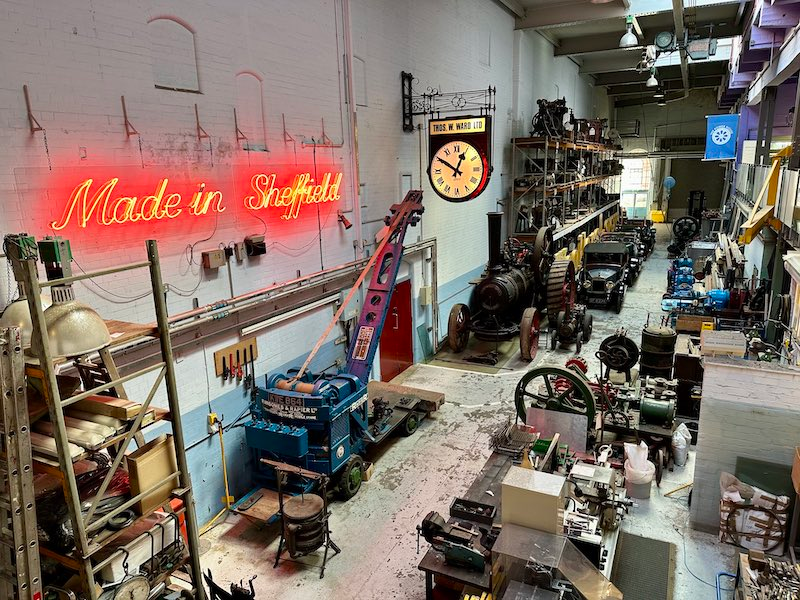
The whole museum tells an engaging story of Sheffield’s industrial past. Exhibits include Little Mesters Street, a recreation of the small workshops used by self-employed craftsmen to create smaller items like cutlery or tools. A reconstruction of James Dixon and Sons’ die-sinkers workshop shows how metal stamps were created to mass produce cutlery and other homeware.
Part of the upper floor is dedicated to a gallery showing vehicles manufactured in Sheffield, including two examples of the regal Sheffield Simplex motor car (though both are on tour at the time of writing).
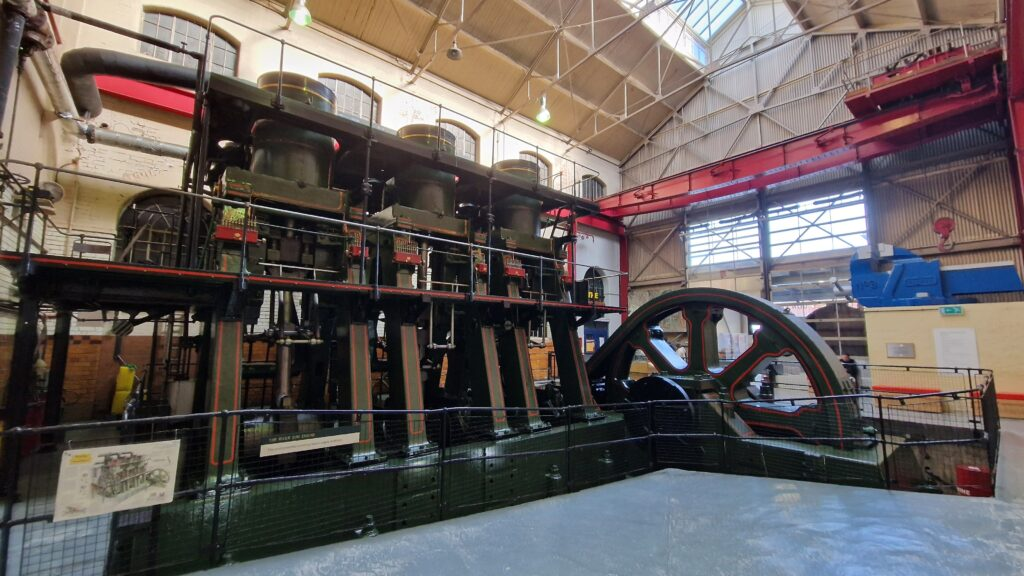
The highlight is the mighty River Don Engine, the largest working steam engine in the UK. The engine is fired up for a display twice a day, and it’s an impressive sight to see this huge machine in operation.
One of four steam engines built in 1905 by Davy Brothers of Sheffield, the River Don was supplied to Charles Cammell’s works at Grimesthorpe. The engine powered a rolling mill that was used to produce armour plating up to 16” thick for Royal Navy battleships. The engine transferred to Vickers’ River Don Works in 1957 where it continued to be used until 1976, including making casings for the UK’s civil nuclear reactors.
How to visit
- Opening times: 10am to 5pm Tuesday to Saturday, 11am – 5pm Sundays (the River Don Engine operates at midday and 2pm from Thursdays to Sundays).
- Price: Entry is free, though donations are encouraged.
- Getting There: The museum is a 25 min walk from Sheffield station, or 15 mins with bus 95/95a.