
History
Tucked away in the northwestern corner of Lithuania, near the border with Latvia and Belarus, is the Ignalina Nuclear Power Plant. Notable for containing the only examples of ‘Chernobyl-style’ RBMK nuclear reactors in the European Union, and now the site of a complex decommissioning project, Ignalina NPP offers a fascinating visitor experience.
Ignalina NPP was initiated in the 1970s to generate electrical power for the then Soviet republics of Lithuania, Latvia and Belarus. The plant was sited next to Lake Drūkšiai to provide a source of water to cool the reactor, and involved the construction of a new town, Visaginas, to house the 5,000 people who worked at the plant. Ignalina NPP employed the RBMK light-water, graphite-moderated design also used at Chernobyl and several other locations in the former Soviet Union. Two such reactors were built, Units 1 and 2, which came online in 1983 and 1987 respectively – the latter after modifications prompted by the Chernoblyl disaster of the previous year.
Given the safety risks of the RBMK design, including the lack of a containment vessel, Lithuania was required to shut down and decommission Ignalina NPP as a condition of their accession to the European Union. Unit 1 was closed in 2004, in the year that Lithuania joined the EU.
Ignalina provided the majority of Lithuania’s electricity – 70% in 2009 – and fears of a rise in electricity prices and increased dependence on energy imports from Russia promoted a referendum in 2008 on whether to proceed with the closure. A majority were in favour of keeping Ignalina open, but with turnout failing to meet a majority threshold, Unit 2 closed in 2009. Since the closure of Unit 2, Lithuania has expanded the natural gas and oil-fueled Elektrėnai Power Plant and relied on increased electricity imports, particularly from Sweden.
A decades-long decommissioning project is now underway. Originally expected to conclude by the late 2020s, the unique nature of the project – the first to decommission a RBMK reactor in this way – has increased costs and stretched timelines. The final cask of spent fuel was removed to a storage facility on the site in 2022, and physical dismantling of the reactors is expected to start in 2028 with a planned completion date of 2038. An Ignalina International Decommissioning Support Fund has been established by the European Bank for Reconstruction and Development with funding from the European Union and a number of European countries.
Visiting Ignalina
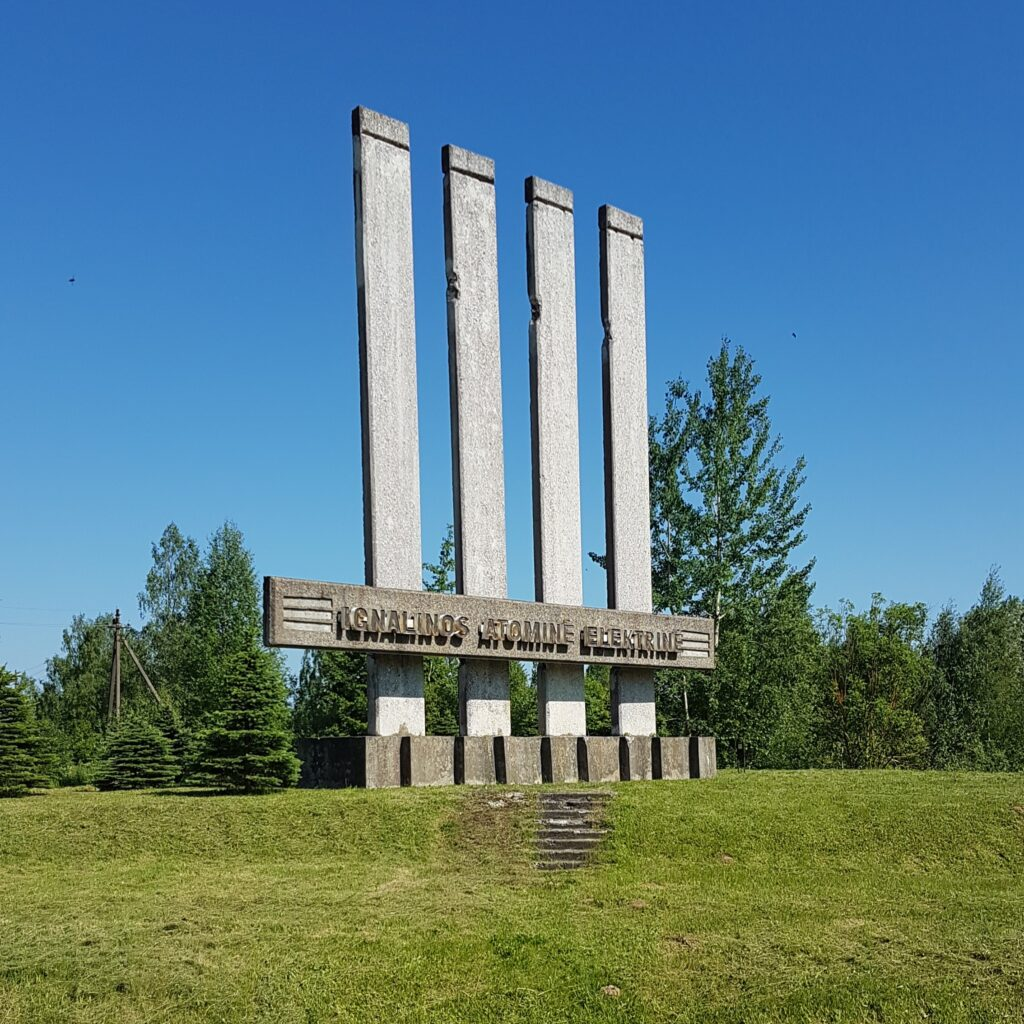
We visited Ignalina in May 2018 as part of a road trip around Lithuania. At the time this involved writing a letter to the plant director explaining why we wanted to visit, but procedures have now changed, visits to the plant having become more popular as it was used as a filming location for the HBO drama Chernobyl. There are now two options:
-
- A 1 hour tour of the visitor centre, every working day at 10.00 and 13.00, free of charge but registration required.
-
- A 3 hour tour of the controlled area within the plant, taking place on Wednesdays, Thursdays and Fridays at 10.30, at €70 per person. These also requires booking in advance, and are already fully booked until the end of 2023.
Whilst it requires more advance planning, the latter is highly recommended. The tour begins with a safety briefing, and then you are required to change into protective clothing – overalls, shoe covers, a hard hat and a radiation monitor – before entering the controlled area through radiation scanners.
A car is easiest in getting to Ignalina NPP – we were coming from Kaunas and the drive took a little under 3 hours, mostly through the peaceful Lithuanian countryside. We then returned to Vilnius, which was around 2 hours.
Trains between Vilnius and Visaginas depart every couple of hours, take 2 hours and 15 mins, and cost €8.60 at the time of writing. You will need to factor in time to get a taxi from Visaginas to Ignalina NPP and you may wish to either arrange a taxi in advance, or download a booking app. Oh, and be sure to go to Visaginas and not Ignalina – the town of Ignalina is 30 km or so away from Ignalina NPP.
Do check but when we visited the tour would not have been suitable for those with limited mobility given the need to walk up and down multiple flights of stairs, and along long corridors – it’s a big place!
To find out more or to book, go to https://www.iae.lt/en/private-tours/593
Our Experience
You first visit the reactor hall, where the floor is made up of several hundred square fuel channels covers, forming the circular top of the reactor vessel. You can also see the tall crane assembly used to replace fuel rods when the reactor was in operation.
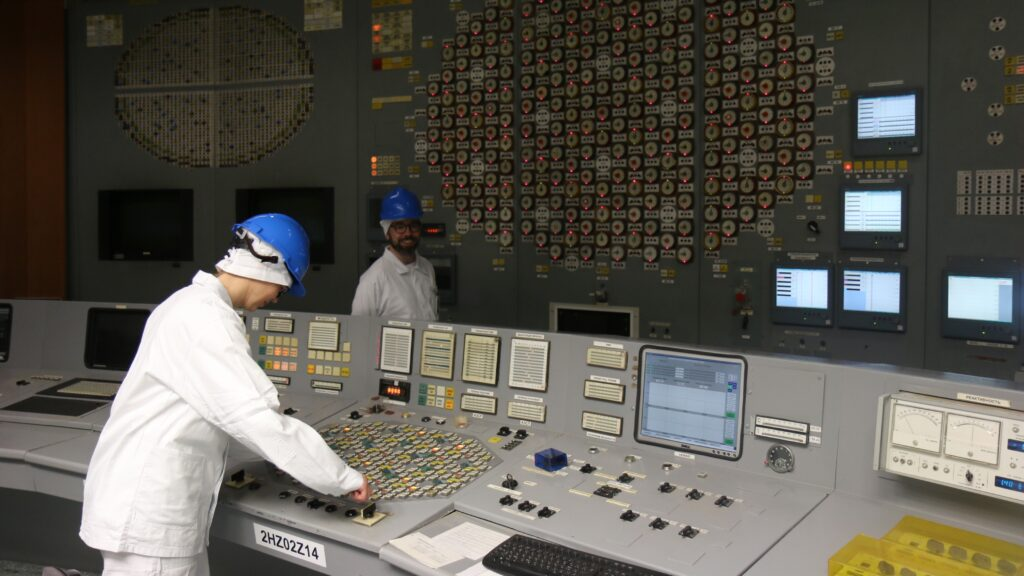
From there you move through the corridors of the plant, and up several flights of stairs, to the reactor control room. There you’re given a comprehensive explanation of a bewildering array of switches, dials, and schematics – including the AZ-5 button made famous by Chernobyl, which fully inserts the control rods.
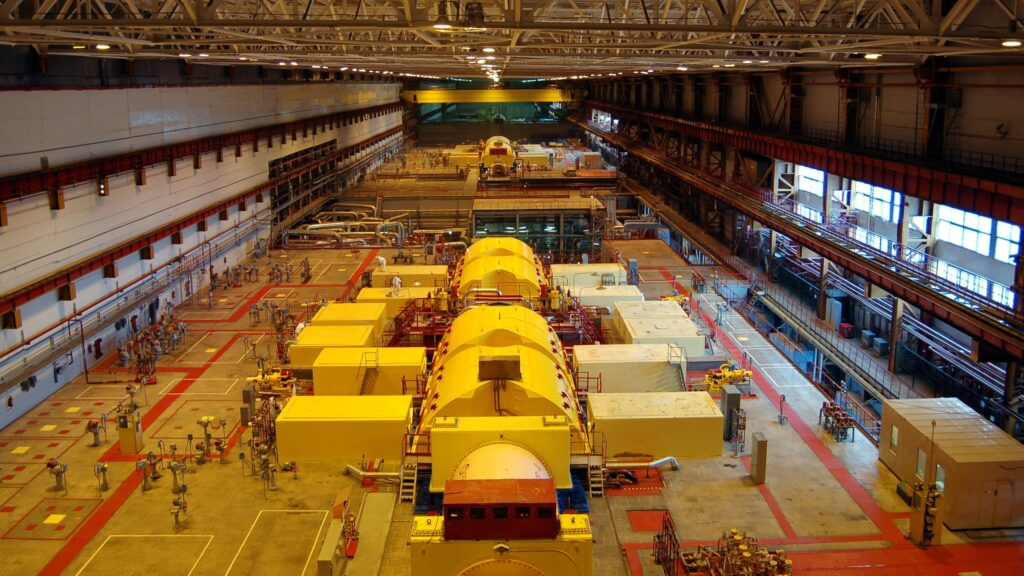
The final stop, along more corridors and up and down more stairs, is the turbine hall. This is a huge space, several hundred metres long, which originally housed the vast steam turbines used to generate electricity. Those turbines and accompanying equipment – 18,000 tonnes in all – were removed by 2016, and so the guide has photos to show how the hall would have looked when in operation.
You’re then brought out of the controlled area via the radiation scanners, and able to change back into your normal clothes. Our tour probably lasted a little less than 3 hours, possibly because there were only 4 of us, but it was certainly comprehensive, and we benefited from an expert guide who had worked at the plant when it was in operation.